
Gemini:
the encoder digests and understands the input data, while
the decoder generates new output data based on that understanding.
=-=-=-=-=-=-=-
During Training:
Internal Composition of the Transformer Architecture

Core Internal Components Explained
1. The Encoder Sub-Layers
The Encoder’s responsibility is to break down raw text input into rich mathematical context vectors:
- Input Embedding & Positional Encoding: Words are converted into continuous vectors. Because Transformers process all words simultaneously, a fixed wave-like mathematical function (sine/cosine) is added to give each word a physical coordinates marker.
- Multi-Head Self-Attention: This allows the model to map the relationship between every single word in the sentence simultaneously. “Multi-head” means the model runs this computation multiple distinct times in parallel to pay attention to different context cues (e.g., matching pronouns with nouns, or verbs with objects).
- Position-Wise Feed Forward Network (FFN): A dedicated, standard deep-learning neural network block. It processes each token’s attention-enriched vector independently to apply non-linear mathematical transformations, mapping deeper abstract concepts.
- Residual Add & Norm Connections: Bypasses surround both major sub-layers. They add the original raw input back into the computed output (
Add) before applying Layer Normalization (Norm). This prevents mathematical signals (gradients) from shrinking or exploding during deep training loops.
2. The Decoder Sub-Layers
The Decoder mirrors much of the Encoder but features key structural additions to safely generate text one word at a time:
- Masked Multi-Head Self-Attention: Identical to the Encoder’s self-attention, but with an algebraic “mask” applied to future positions. During training, this enforces that word #3 can only look at words #1 and #2, completely blocking access to word #4.
- Multi-Head Cross-Attention (Encoder-Decoder Attention): This is the bridge layer between both main modules. It takes the Query (Q) matrices generated by the decoder’s prior layer and matches them against the Key (K) and Value (V) matrices streamed directly over from the final output layer of the Encoder. This is how the generator constantly checks back against the original user prompt for context accuracy.
- Linear & Softmax Projection: The ultimate output vectors pass into a final standard linear projection layer that scales the vectors to match the size of the model’s vocabulary list. The Softmax mathematical function translates those numbers into precise probability percentages, selecting the single highest-probability next token.
Why the Layout reflects Training
- The Cross-Attention Bridge: The arrows flowing directly from the top of the Encoder into the middle of the Decoder show the system running in tandem. In training, this happens in one highly parallelized heartbeat.
- The Masked Self-Attention Layer: This specific block is structurally designed for the Learning phase. It uses a mathematical matrix mask to simulate time. It forces the decoder to practice predicting words without looking ahead, even though the entire text is fed into the system at once.
=-=-=-=-=-=-=-=-=-=-=-=-=-=-0
a live Inference (Application) environment, the structural blocks remain identical, but the data flow changes:
- The Encoder is Uncoupled: The Encoder block would only run once at the very beginning to process your prompt. Once it creates the Key (\(K\)) and Value (\(V\)) matrices, it goes idle.
- The Cross-Attention becomes a Static Cache: The lines bridging the Encoder to the Decoder would no longer pass active, changing data. Instead, they would point to a frozen memory cache (called the KV Cache) that the Decoder repeatedly references.
- The Decoder becomes a Loop: The output at the very top (Softmax) would feature a physical feedback arrow routing back into the “Output Embeddings” at the bottom right. The diagram would loop continuously until a stop token is produced.
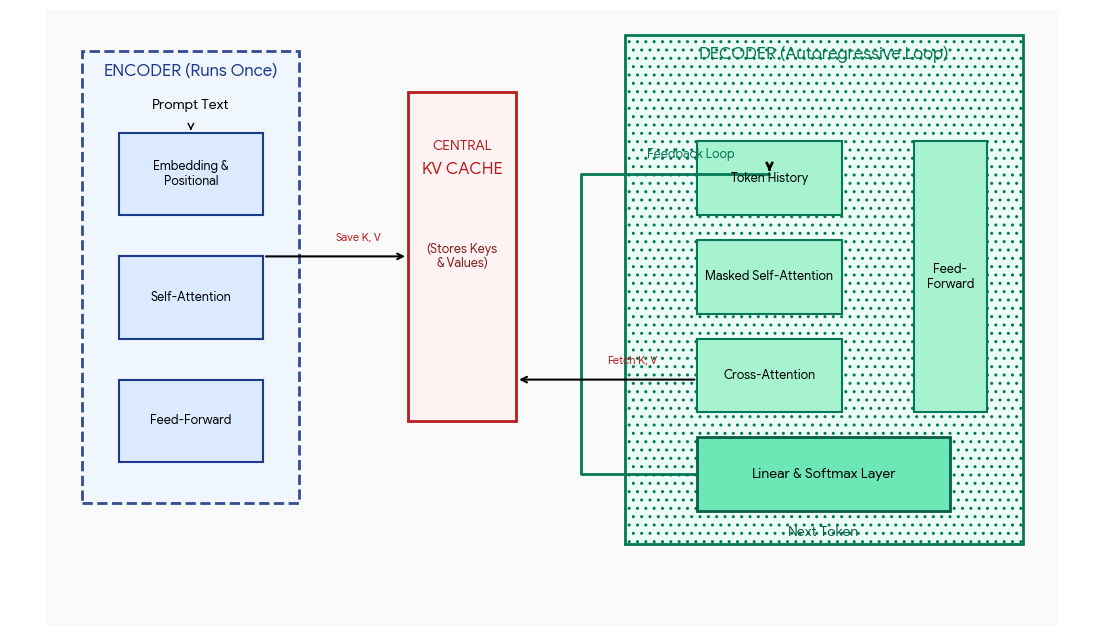
The Transformer Architecture in Inference Context
Step-by-Step Inference Execution
Step 1: The One-Time Encoder Pass (Contextualization)
When you submit a prompt (e.g., “Translate ‘Hello’ to French”), the model initiates the inference process:
- The User Prompt passes through the Encoder layers.
- The Encoder calculates the contextual relationships of your prompt and transforms them into definitive mathematical matrices: Keys (K) and Values (V).
- The KV Cache Save: These matrices are written into a static memory cache. Because your prompt does not change, the Encoder freezes and never runs again for this entire session, saving massive amounts of computational power.
Step 2: The Decoder Initialization
The Decoder must kickstart the generation process, but it has no text of its own yet:
- The system feeds a mandatory, invisible
<SOS>(Start of Sentence) token into the Decoder. - The Decoder processes this token to prepare its initial queries.
Step 3: The Autoregressive Generation Loop (Repeating)
This is where the model dynamically generates text word by word. For every single word produced, the Decoder executes this entire internal loop:
- 1. Self-Attention Processing: The Decoder looks at the history of what it has generated so far during this session (e.g., if it has already generated “Bonjour”, it analyzes “Bonjour”).
- 2. Cross-Attention Fetching: The Decoder uses its current state to query the frozen KV Cache provided by the Encoder. It asks: “Based on the word I am writing right now, what parts of the original user prompt should I be looking at?”
- 3. Next-Token Projection: The data passes through the Feed Forward layer, and the Linear & Softmax layer calculates a probability distribution across the model’s entire vocabulary. It selects the single word with the highest probability (e.g., “mon”).
- 4. The Feedback Loop: The newly predicted word (“mon”) is immediately appended to the text history. This updated history (“Bonjour mon”) is routed straight back down into the bottom of the Decoder to start the next iteration.
Step 4: The Loop Termination
The Decoder loop repeats endlessly until one of two conditions is met:
- The Softmax layer selects the specialized
<EOS>(End of Sentence) token, signaling that the AI has finished its thought. - The sequence length hits a hard-coded safety boundary (the model’s max context limit).
- The Static KV Cache: Notice how the Encoder is physically disconnected from the direct live loop. It dumps its data into a memory reservoir (the KV Cache) and goes quiet. The Decoder pulls from this static cache on every turn without re-running the Encoder.
- The Feedback Loop Arrow: The most critical change is the structural route from the top Softmax layer straight back down to the Output Embeddings at the bottom right. This represents the autoregressive property: every single word the model outputs is immediately fed back into its own input history so it can calculate the next word.
- Centralized KV Cache Box: Placed squarely between the Encoder and Decoder blocks. This clarifies how the Encoder can shut down immediately after its first calculation, leaving its contextual results accessible to the generation loop.
- The Closed Autoregressive Loop: The feedback line from the final Linear & Softmax token selection step back down to the Token History/Embeddings block is fully self-contained, representing how the model feeds its own output back into itself.
- Isolated Data Inputs: The initial user prompt on the left and the rolling text generation on the right are explicitly separated, showing that the system handles user input and text synthesis as two distinct computational pipelines during application.
=-=-=-=-=-=-=-=-=-=-=-=-=-
1. Autoregressive Decoders (GPT-style)
- Definition: A neural network architecture (specifically a decoder-only Transformer) designed to generate data by predicting the next element in a sequence based exclusively on its own previous outputs. [1, 2]
- The Engineering Mechanics: Given a sequence of tokens \(X = (x_1, x_2, \dots, x_t)\), the model decomposes the joint probability distribution into a product of conditional probabilities:
\(P(X)=\prod _{i=1}^{t}P(x_{i}\mid x_{1},x_{2},\dots ,x_{i-1})\) - Why It Matters: Because the model cannot “look ahead,” it is structurally optimized for left-to-right generation tasks (like typing code or generating dialogue). During inference, it operates sequentially—each generated token is appended back to the input to become part of the history context for the next iteration. [1, 2]
2. Causal Language Modeling (CLM)
- Definition: The specific pre-training task where a neural network is trained to predict the single next token given a history of preceding tokens. [1, 2]
- The Engineering Mechanics: The model is optimized using a cross-entropy loss function over a web-scale corpus. Unlike bidirectional models (like BERT) that use context from both left and right to fill in the blanks, a causal language model enforces a strict arrow of time. [1, 2]
- Why It Matters: CLM forces the network to compress semantic, syntactic, and logical relationships directly into its fixed parameter weights. To predict the next word accurately across millions of diverse texts, the network must implicitly learn to track variables, evaluate code, and maintain context. [1, 2]
3. Masked Attention Maps & Context Conditioning
- Definition: A matrix multiplication override operation that strictly prevents a token from attending to future tokens during parallel batch training.
- The Engineering Mechanics: In standard self-attention, a dot-product is calculated between all Queries (Q) and Keys (K) to score how much tokens relate to each other: \(\text{Attention Score} = QK^T\). To enforce causality during parallel batch processing, a lower-triangular Causal Mask Matrix is added to this score before running it through the Softmax layer:
\(\text{Causal\ Mask}_{ij}=\begin{cases}0&\text{if\ }j\le i\\ -\infty &\text{if\ }j>i\end{cases}\) - Why It Matters: Adding -∞ to future token positions forces their Softmax weights to exactly 0. This allows the model to process an entire 4,000-token sequence in parallel on the GPU during training without “cheating” by peeking at the answers ahead. It ensures token predictions are strictly conditioned on past context. [1]
