
let X with pdf of f(x) be
f(x) = \frac{1}{{\sigma \sqrt {2\pi }} }e^{ – \frac {{(x – \mu)}^2 }{2\sigma^2} }

Y=X^2
dy/dx=2x
dx=dy/2x
Cumulative probability function of of Y will
be


Because of symmetry of X and X^2

=P(-\sqrt{y}\leqslant x \leqslant \sqrt{y})

Y=X^2
dy/dx=2x
dx=dy/2x
G(y)=2\int_{0}^{\sqrt{y}}{\frac{1}{{\sigma \sqrt {2\pi }} }e^{ – \frac {{(x – \mu)}^2 }{2\sigma^2} }}dx


therefore
pdf for y

pdf(y)=\frac{2}{\sigma \sqrt {2\pi } 2 \sqrt y} {e^{ – \frac {{(\sqrt y – \mu)}^2 }{2\sigma^2} }}

pdf(y)=\frac{2}{ 2\sqrt {y}\sqrt {2\pi} } {e^{ – \frac {y }{2} }}
Below we can show that the formula above a Chi squared distribution.
For Z=(x-mu/Sigma)
=======================================================
if mu=0 and sigma=1 which means standard normal distribution Y=z^2
we can replace Sqrt(pi) with gamma function

we know

then

pdf(Z)=\frac{y^{(\frac {k}{2}-1)}{e^{ – \frac {z }{2} }}}{ 2^{(1/2)} \Gamma (1/2) }
compared with general Gamma distribution
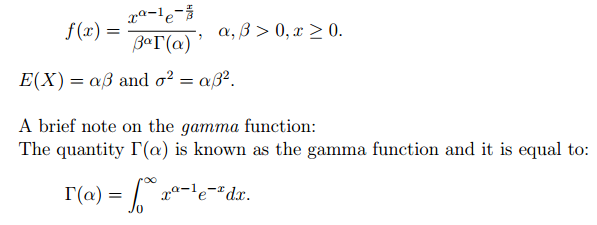
This is Gamma distribution shape alpha 1/2 and scale beta of 2
mean of 1 and variance of 2
and we call it Chi square distribution with 1 degree of freedom.
