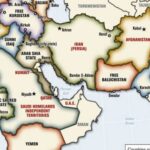
1. The Multi-Ethnic Composition (The Fault Lines)
- Many of these populations live in border provinces directly adjacent to co-ethnic populations in neighboring countries (e.g., Azeris next to Azerbaijan, Kurds next to Iraqi/Turkish Kurdistan, Balochis next to Pakistani Balochistan). [12, 13, 14, 15, 16]
- Foreign intelligence agencies and rival nations have historically viewed these borderlands as internal geographic vulnerabilities. It is far easier to sponsor an existing indigenous separatist or autonomist movement to pressure Tehran than it is to launch a direct military invasion.
2. Depriving the State of Strategic Resources (The Economic Blow)
- The Arab/Khuzestan region (Ahwaz): This southwestern province contains the vast majority of Iran’s oil and gas reserves, as well as its primary access to the Persian Gulf. During the 1980 invasion, Saddam Hussein knew that if Iraq could sever Khuzestan, Iran would be stripped of its economic lifeline and reduced to a landlocked, resource-poor state. [18, 19, 20, 21, 22]
- Sistan-Balochistan: This southeastern region holds Iran’s only direct access to the Indian Ocean via the deep-water port of Chabahar. Disrupting or severing this area cuts off Iran’s vital trade links to South Asia and China. [23, 24]
3. Creating Buffer States and Stopping Expansion
- The British Empire sought a fragmented western and eastern Iran to create buffer zones that would protect British India from Russian encroachment.
- The Soviet Union attempted to carve out Soviet-backed puppet republics in Iranian Azerbaijan and Kurdistan in 1945–1946. Moscow’s goal was to secure permanent client states on its southern border, dominate the oil fields of northern Iran, and prevent the United States and Britain from establishing military bases right on the Soviet flank. [26, 27]
4. Asymmetric Warfare and “Regime Containment”
- Because direct conventional military conflict with Iran is highly risky and economically devastating, foreign adversaries have analyzed “internal balkanization” as an alternative strategy. [33, 34]
- By covertly funding, arming, or politically legitimizing minority insurgencies (like Baloch or Kurdish groups), external powers attempt to force Tehran to divert its military attention and financial resources inward. The strategic logic is that a government fighting multiple domestic border rebellions has less capacity to project power abroad. [35]
Summary of the Strategic Logic
Great Powers and Small States: Exploitation, Dependency, and Asymmetry
Multiple sources from across political spectrums acknowledge that big powers often find it advantageous to deal with smaller, less self-sustainable states – and there are many contemporary examples of economic dependency, military reliance, and political subordination that illustrate this global principle.
Western critics (especially from the Global South or leftist traditions) emphasize how the U.S. and European powers maintain neocolonial relationships – through debt, trade, and political influence – that keep many African, Latin American, and Asian states dependent. We saw how French monetary policies in West Africa or American backing of client regimes serve to extract benefits (resources, loyalty, strategic access) from those states[8][17].
Alternative and non-Western media further underline this with strong rhetoric: Chinese state media calls the U.S. a “slavery empire” that “enslaves countries to serve its interests” via the dollar and military power[45][46], citing the banana republics and decades of Latin American exploitation as evidence[11][47].
On the other hand, Western think tanks accuse China and Russia of “buying influence” in weak states to turn them into vassals, pointing to things like BRI debt and Wagner mercenaries as new forms of exploitation[31][21].
Each side highlights the other’s penchant for dominating small nations – and, notably, each uses the treatment of small states as a moral differentiator (e.g., the U.S. claiming it treats small allies as friends, not underlings[19]). The reality illustrated by all these sources is that structural asymmetry – big vs small – inherently lends itself to exploitation, regardless of ideology. Even when couched as “help” or “partnership,” the great power usually ends up with the upper hand.
Since 1970, many newly independent or developing states have discovered that political sovereignty did not guarantee economic independence or security autonomy. They often had to align with a superpower or enter the global market on unequal terms, leading to what Kwame Nkrumah termed “neo-colonialism: the last stage of imperialism.” Whether it’s Western banks dictating austerity in an African capital, or Russian generals brokering a deal in an African jungle, or Chinese contractors building a mega-project that a small nation must repay – the pattern is recognizable. Great powers and their proxies exploit the weaknesses of small states, while small states seek great-power patrons to survive – a mutually reinforcing cycle of dependency. As one Global South economist put it, “The dominant imperialist countries control the rest of the world through economic exploitation…this is the essence of modern imperialism” (Roberts 2023)[5]. And as an Iranian official warned, from his vantage point, “the US and Israel” prefer a fractured neighborhood to an assertive one[41].
Ultimately, the question of whether big powers “prefer” smaller, unsustainable states might be answered by paraphrasing an old saying:
great powers don’t have friends, they have interests – and it can be in their interest that you stay small.
Where there is structural asymmetry, there is potential for exploitation. Smaller states that cannot stand on their own economically or militarily often become arenas for great-power competition or tools for great-power gain. Whether one labels it imperialism, dependency, clientelism, or partnership is largely a matter of perspective – but the underlying power imbalance is a constant of contemporary geopolitics.
=-=-=-=-=-=-=-=-=-=-=-=-=-=-=-=-=-
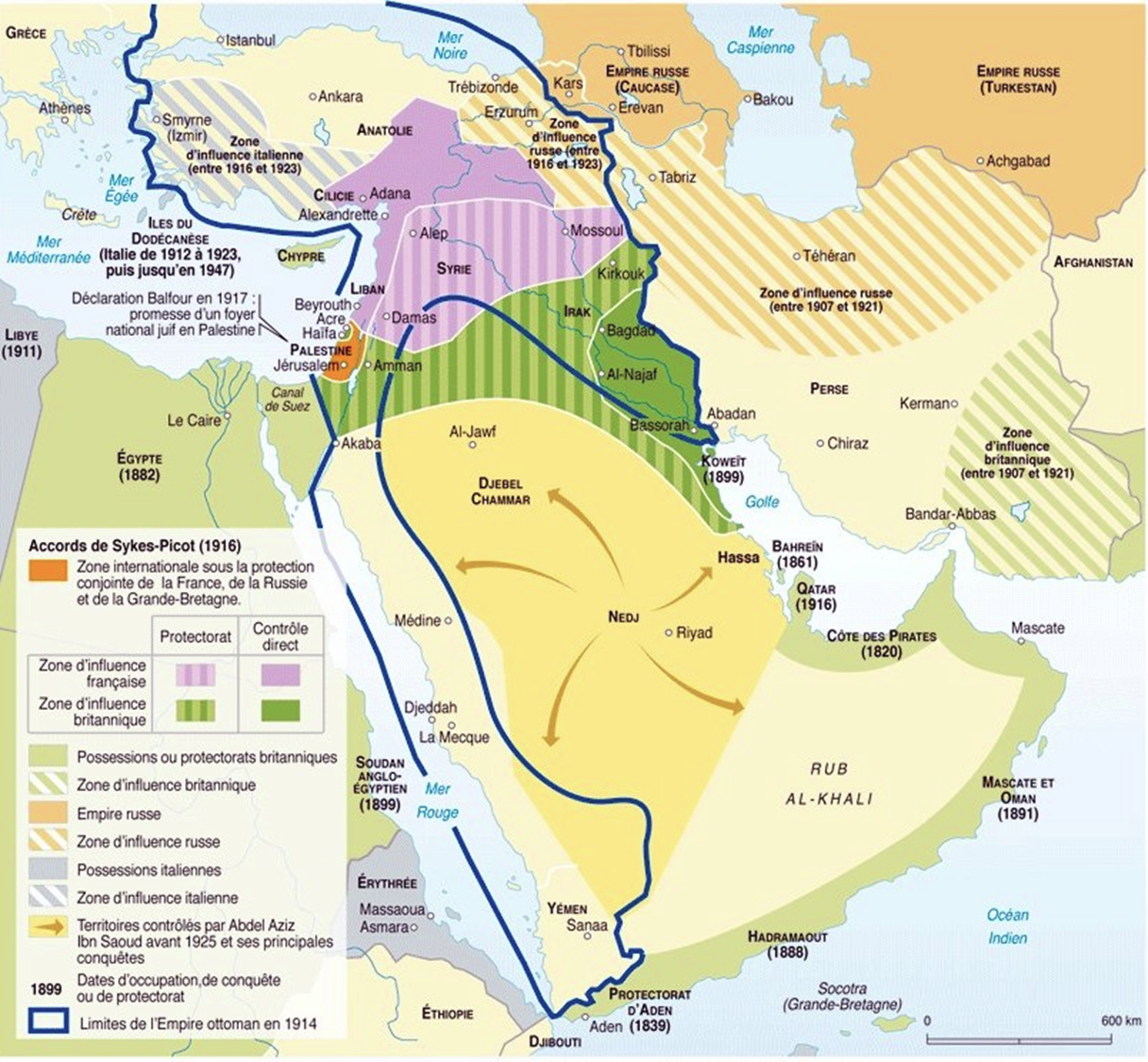
The Sykes–Picot Agreement (/ˈsaɪks ˈpiːkoʊ, – pɪˈkoʊ, – piːˈkoʊ/[1]) was a 1916 secret treaty between the United Kingdom and France, with assent from Russia and Italy, to define their mutually agreed spheres of influence and control in an eventual partition of the Ottoman Empire.
The agreement was based on the premise that the Triple Entente would achieve success in defeating the Ottoman Empire during World War I and formed part of a series of secret agreements contemplating its partition. The primary negotiations leading to the agreement took place between 23 November 1915 and 3 January 1916, on which date the British and French diplomats, Mark Sykes and François Georges-Picot, initialled an agreed memorandum.[2][3] The agreement was ratified by their respective governments on 9 and 16 May 1916.[4]

=-=-=-=-=-=-=-=-=-=-
Ariel Sharon
In an interview with the Israeli daily Maariv on 18/12/1981, a few months before the invasion he led against Lebanon, then-Defense Minister Ariel Sharon said that the conditions were favorable for the fragmentation of the Arab states and the extension of Israeli dominance in the region.
Sharon spoke about the potential conflict between Shiites, Sunnis and Kurds in Iraq, between Sunnis and Alawites in Syria and between rival sects in Lebanon, and also between Palestinians and Bedouins in the east of Jordan, between Sunnis and Shiites in the Eastern Province in Saudi Arabia, and between Muslims and Copts in Egypt. He even spoke about conflict between the Muslim north and the animist-Christian south in Sudan, and between Arabs and Berbers in the Maghreb region.
Saleh, Mohsen Mohammad. 2013. “A Reading on the Calls for Sectarian and Ethnic Fragmentation.” Al‑Zaytouna Centre for Studies and Consultations, February 23, 2013. https://eng.alzaytouna.net/2013/02/23/a-reading-on-the‑calls‑for‑sectarian‑and‑ethnic‑fragmentation/
=-=-=-=-=-=-=-=-=-=-=-=-=-
The 1982 Oded Yinon Plan
by Oded Yinon
This essay originally appeared in Hebrew in KIVUNIM (Directions), A
Journal for Judaism and Zionism; Issue No, 14–Winter, 5742, February
1982, Editor: Yoram Beck. Editorial Committee: Eli Eyal, Yoram Beck,
Amnon Hadari, Yohanan Manor, Elieser Schweid. Published by the
Department of Publicity/The World Zionist Organization, Jerusalem.
In 2017, Ted Becker and Polkinhorn, argued that Yinon’s plan was adopted and refined in a 1996 policy document entitled A Clean Break: A New Strategy for Securing the Realm, written by a research group at the Israeli-affiliated Institute for Advanced Strategic and Political Studies in Washington. The group was directed by Richard Perle, who, some years later, became one of the key figures in the formulation of the Iraq War strategy adopted during the administration of George W. Bush in 2003.[9] They admit that enemies of Israel in the Middle East take the sequence of events—Israel’s occupation of the West Bank, the Golan Heights, its encirclement of Gaza, the invasion of Lebanon, its bombing of Iraq, airstrikes in Syria and its attempts at containing Iran’s nuclear capacities—when read in the light of the Yinon Plan and the Clean break analysis, to be proof that Israel is engaged in a modern version of The Great Game, with the backing of Zionist currents in the American neoconservative and Christian fundamentalist movements. They also conclude that Likud Party appears to have implemented both plans.[41]
=-=-=-=-=-=-=-=-=-=-=-=-=-=-=-=-=-=-=-=-=-=-=-=-
Bernard Lewis (an influential British-American Middle East scholar)
Bernard Lewis did speculate in the 1990s that Iran’s Islamist revolution could eventually lead to internal instability, chaos, or even disintegration along ethnic lines.
Lewis, a prominent historian of the Middle East, often analyzed the region through the lens of historical patterns, state legitimacy, and ethnic-sectarian tensions. He argued that Iran—a multiethnic state with a Persian majority but significant Azeri, Kurdish, Arab, and Baluch minorities—could face challenges to its territorial integrity if central authority weakened.
In his writings and interviews, Lewis suggested that the Islamic Republic’s ideological rigidity, economic mismanagement, and repression of minority groups might fuel separatist tendencies. He pointed to historical precedents, such as the collapse of multinational empires (e.g., the Ottoman Empire), to argue that similar pressures could destabilize Iran, particularly if the regime lost its grip on power.
However, Lewis’s predictions were speculative, and Iran has so far defied such scenarios despite periodic unrest among minorities. Critics argue that his views sometimes overstated ethnic divisions while underestimating the regime’s resilience and the unifying force of nationalism (even under an Islamist system). His close ties to pro-Israeli and neoconservative circles also led some to see his analysis as politically motivated, particularly in the context of U.S.-Iran tensions.
-
The Shaping of the Modern Middle East” (1994)
-
Lewis argues that multiethnic states in the Middle East (including Iran) are vulnerable to disintegration if central authority weakens, drawing parallels to the Ottoman Empire’s collapse.
-
Discusses Persian-dominated Iran’s minority identities (Kurds, Azeris, Baluch, Arabs) as a potential source of instability.
-
-
“The Multiple Identities of the Middle East” (1998)
-
Lewis examines how competing identities (ethnic, religious, tribal) could challenge Iran’s Islamist regime, especially if economic or political crises erupt.
-
Suggests that minority unrest (e.g., in Khuzestan or Kurdistan) could escalate if the state loses coercive capacity.
-
-
Interview in The Atlantic (1998): “Looking at History, Looking Ahead”
-
Lewis speculates that Iran’s “artificial borders” and “repressive theocracy” might lead to Balkanization, particularly if U.S. pressure intensifies.
-
Claims Azeris and Kurds could seek autonomy or alignment with neighboring states (e.g., Azerbaijan, Iraqi Kurdistan).
-
-
“What Went Wrong? The Clash Between Islam and Modernity in the Middle East” (2002)
-
While focused on broader Middle Eastern decline, Lewis implies that Iran’s mix of ideological rigidity and ethnic diversity makes it prone to fracture under stress.
-
Secondary Analysis:
-
Critiques of Lewis’s Views:
-
Historian Juan Cole (2006) argued Lewis overstated ethnic divisions, ignoring Iranian nationalism’s resilience (“The Shi’a and the Ethnic Bomb” in Middle East Report).
-
Vali Nasr (2006) countered in “The Shia Revival” that sectarian (Shia vs. Sunni) tensions mattered more than ethnicity in Iran’s stability.
-
Relevance to Later Events:
-
Lewis’s predictions echoed in neoconservative circles (e.g., 2000s U.S. debates on regime change in Iran).
-
Despite periodic minority protests (e.g., Arab Khuzestan 2005, Kurdish unrest 2016–present), Iran’s security apparatus has suppressed large-scale separatist movements—so far.
=-=-=-=-=-=-=-=-=-=-=-=-=-=-=-=-=-=-=-=-=-=-=-=-
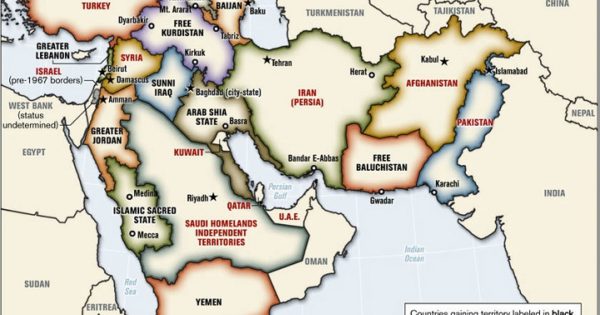
Blood Borders: A Proposal To Redraw A “New Middle East” (Ralph Peters 1 June 2006)
Retired US officer and author Ralph Peters built on Lewis’s ideas, and called for the partitioning of the Middle East in his article “Blood Borders,” published in the US Armed Forces Journal in June 2006. Peters reckoned that the “most arbitrary and distorted borders in the world are in Africa and the Middle East,” which were drawn by “self-interested Europeans.” He wrote, “Yet, for all the injustices the borders re-imagined here leave unaddressed, without such major boundary revisions, we shall never see a more peaceful Middle East.”
He then added, “We are dealing with colossal, man-made deformities,” and urged that “if the borders of the greater Middle East cannot be amended to reflect the natural ties of blood and faith
Of course, Peters failed to speak about the dangerous deformities created by the West, particularly Britain and the United States, by planting Israel in the heart of the Arab and Islamic region.
Interestingly, Peters spoke crudely about partitioning Iraq and Saudi Arabia, and proposed a state for Shia Arabs in southern Iraq which extends to include al-Ihsaa and which would be in control of the oil fields in eastern Saudi Arabia (without including Kuwait), and also extends to include areas southwest of Iran bordering the Gulf, especially Ahwaz.
He also proposed a state for Sunni Arabs in central Iraq and another for the Kurds in northern Iraq, northeastern Syria, eastern Turkey and northwestern Iran. Furthermore, he proposed for the Hijaz to secede from Saudi Arabia, and for Jordan to expand to take parts of northern Saudi Arabia, while Yemen expands north at the expense of southwest Saudi Arabia.
=-=-
Last Updated: March 3, 2023 https://brilliantmaps.com/new-middle-east/
=-=-=-=-=-=-=-=-=-=-=-
- Embrace regime change as a policy. Iran’s leadership has shown time and again that its ideology is impervious to deterrence; military strikes only feed its propaganda. You should publicly declare that the Islamic Republic under Ayatollah Khamenei is an outlaw regime and that its removal is a US strategic objective.
- Sharpen economic warfare to knife-edge precision. Existing sanctions must be intensified to target every revenue stream sustaining the regime. Freeze all assets tied to the IRGC and its Quds Force, sanction the Central Bank of the Islamic Republic of Iran, and levy secondary sanctions on foreign banks and firms transacting with Tehran.
- Ramp up covert operations inside Iran. If Tehran welcomes violence, let it find the fight at home. Expand cyber offensives to disable IRGC command-and-control networks, disrupt missile guidance systems, and interfere with nuclear control software.
- Designate the IRGC a foreign terrorist organization and pursue its global networks relentlessly. Force banks worldwide to choose between processing dollar transactions and facilitating money laundering by the IRGC.
- Project overwhelming military readiness. Surge US carrier strike groups into the Persian Gulf, pre-position Aegis destroyers in the Arabian Sea, and deploy long-range bombers to deter any Iranian reprisal.
- Forge a Middle East coalition for Iran’s partition. Encourage long-term plans for a federalized or partitioned Iran, recognizing that Khamenei’s theocratic regime cannot be reformed. Offer security guarantees to Sunni, Kurdish, and Balochi minority regions willing to break away.
=-=-=-=-=-=-=-=-
2006
Blood Borders
Raph Peters
http://armedforcesjournal.com/blood-borders/
=-=-=-=-=-=-=-=-=-=-=-
2014-
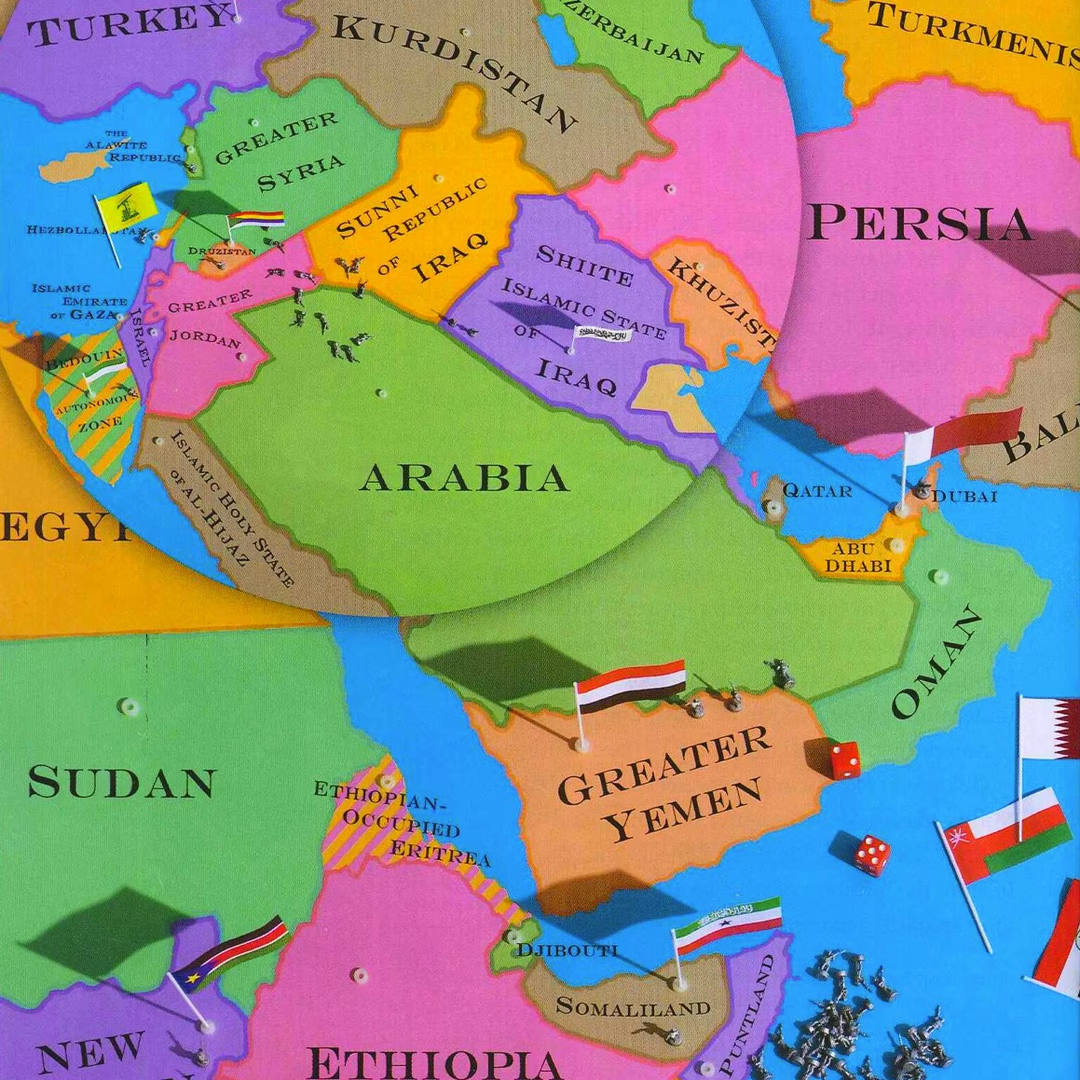
The New Map of the Middle East
Why should we fight the inevitable break-up of Iraq?
By Jeffrey Goldberg
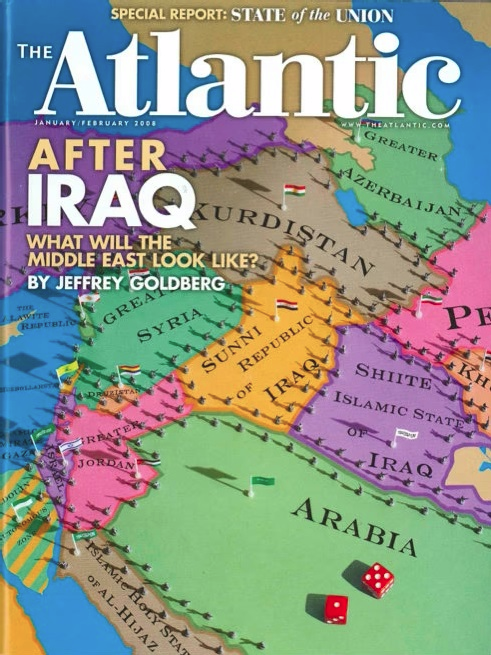
https://www.theatlantic.com/international/archive/2014/06/the-new-map-of-the-middle-east/373080/
=-=-=-=-=-=-
March 2020
Artificial States and the Remapping of the Middle East
Aslı Ü. Bâli*
https://scholarship.law.vanderbilt.edu/vjtl/vol53/iss2/1/
https://law.yale.edu/asli-u-bali
=-=-=-=–=-=-=-=-=-=-=-
2025
By JPOST EDITORIAL
JUNE 18, 2025 05:55
Updated: JUNE 18, 2025 11:54
https://www.jpost.com/opinion/article-858111
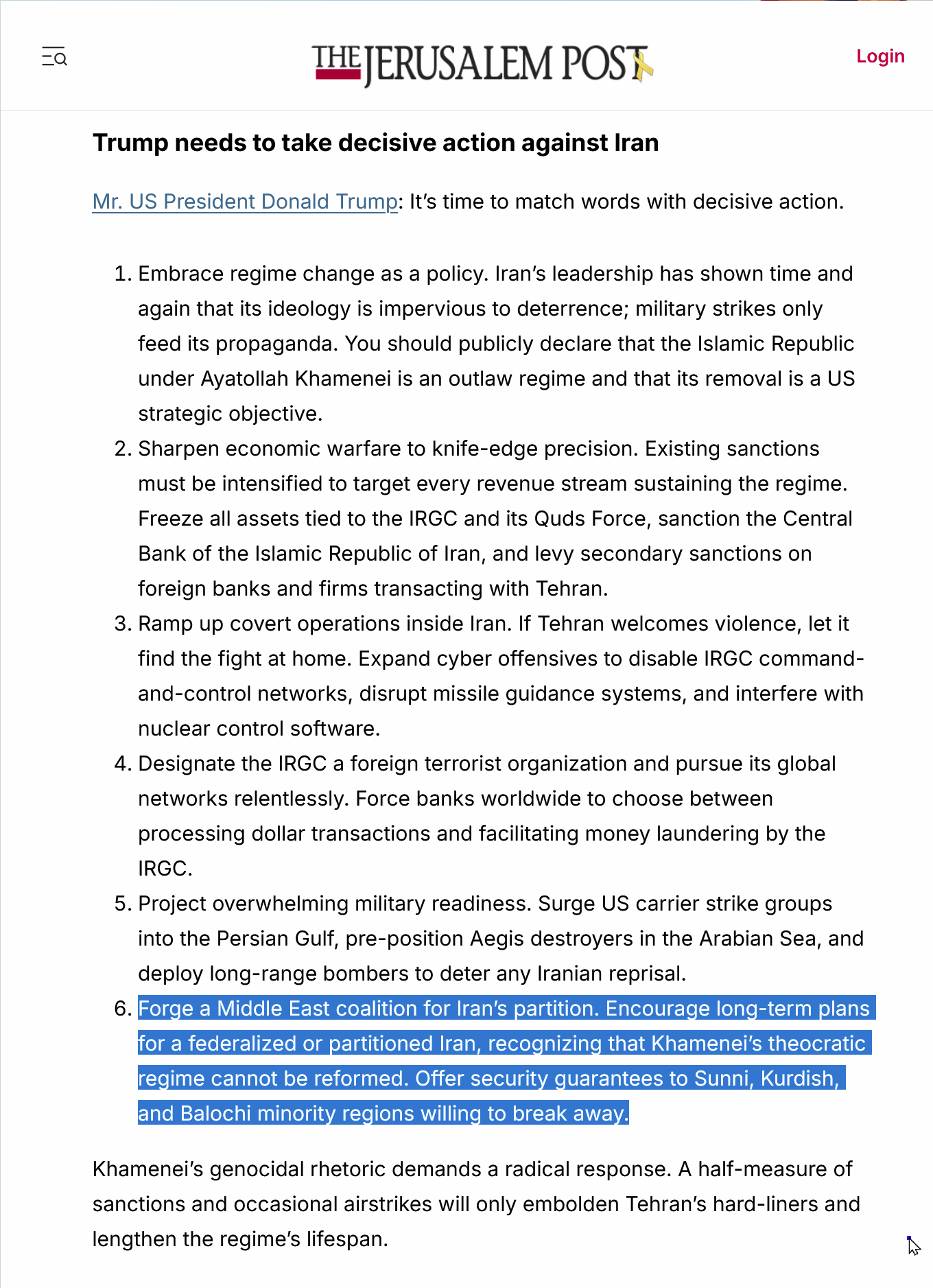
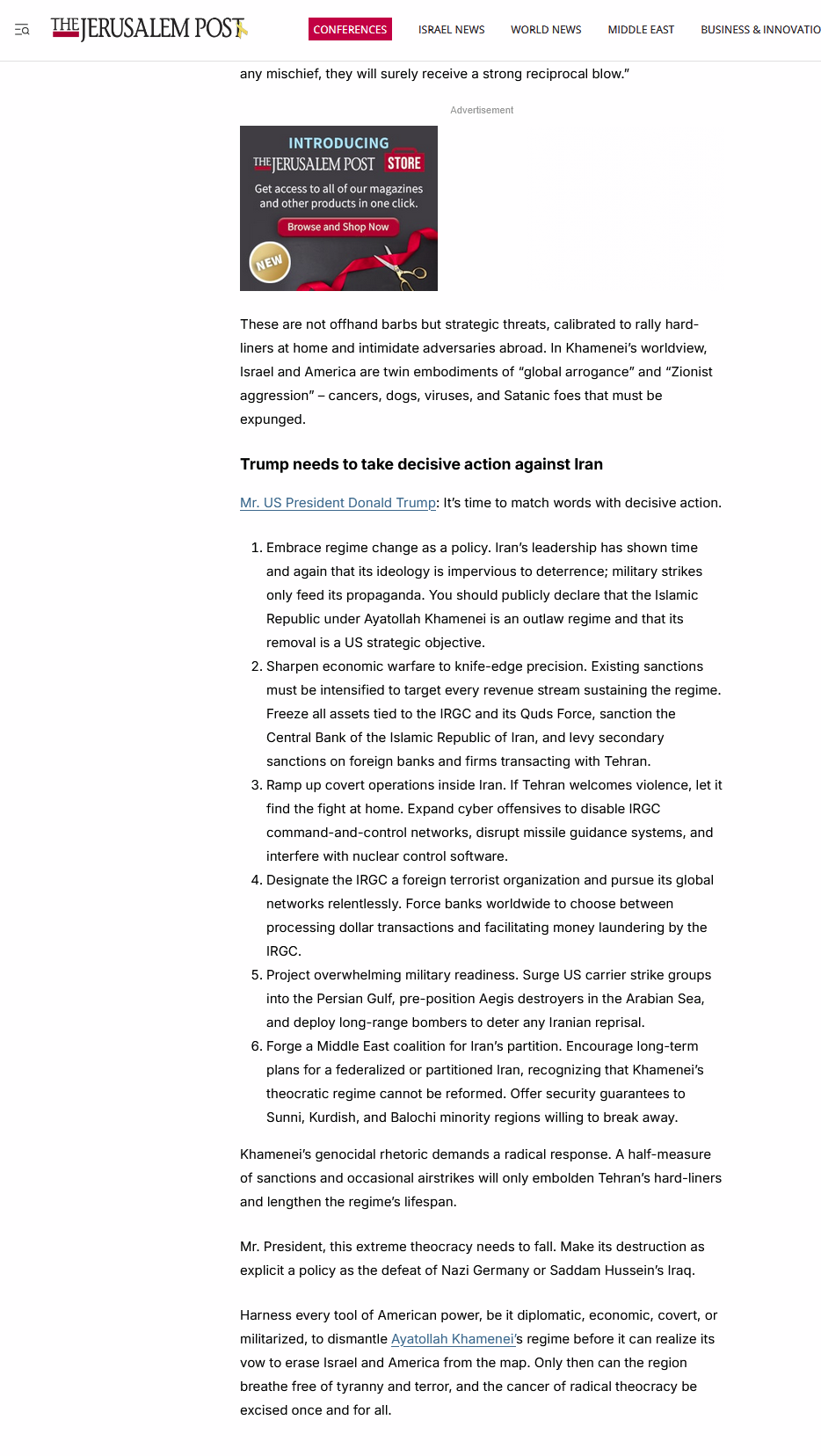
Trump needs to take decisive action against Iran
Mr. US President Donald Trump: It’s time to match words with decisive action.
- Embrace regime change as a policy. Iran’s leadership has shown time and again that its ideology is impervious to deterrence; military strikes only feed its propaganda. You should publicly declare that the Islamic Republic under Ayatollah Khamenei is an outlaw regime and that its removal is a US strategic objective.
- Sharpen economic warfare to knife-edge precision. Existing sanctions must be intensified to target every revenue stream sustaining the regime. Freeze all assets tied to the IRGC and its Quds Force, sanction the Central Bank of the Islamic Republic of Iran, and levy secondary sanctions on foreign banks and firms transacting with Tehran.
- Ramp up covert operations inside Iran. If Tehran welcomes violence, let it find the fight at home. Expand cyber offensives to disable IRGC command-and-control networks, disrupt missile guidance systems, and interfere with nuclear control software.
- Designate the IRGC a foreign terrorist organization and pursue its global networks relentlessly. Force banks worldwide to choose between processing dollar transactions and facilitating money laundering by the IRGC.
- Project overwhelming military readiness. Surge US carrier strike groups into the Persian Gulf, pre-position Aegis destroyers in the Arabian Sea, and deploy long-range bombers to deter any Iranian reprisal.
- Forge a Middle East coalition for Iran’s partition. Encourage long-term plans for a federalized or partitioned Iran, recognizing that Khamenei’s theocratic regime cannot be reformed. Offer security guarantees to Sunni, Kurdish, and Balochi minority regions willing to break away.
Khamenei’s genocidal rhetoric demands a radical response. A half-measure of sanctions and occasional airstrikes will only embolden Tehran’s hard-liners and lengthen the regime’s lifespan.
The report “Regime Collapse in Iran: A Necessity for Regional Stability?” by Barak M. Seener (Henry Jackson Society, 2025) argues that only the collapse—not reform—of the Islamic Republic can secure regional stability. Its logic proceeds from diagnosis of the regime’s internal fragility to prescriptions for Western and Israeli policy.
1. Executive Thesis
Iran’s military setbacks after the 12-Day War (June 2025)—Israeli-U.S. strikes on nuclear and IRGC sites—exposed the regime’s brittleness and the erosion of the Supreme Leader’s authority. Seener asserts that deterrence requires deliberate regime collapse, not mere containment. He recommends simultaneous military, informational, and economic pressure combined with inducements for defection and coordination of opposition groups (Seener 2025, pp. 5–8).
2. Causal Logic
- Core claim: the regime’s ideological structure—not its policies—drives regional aggression; therefore, neutralizing proxies or enrichment sites is insufficient (pp. 5–6).
- Goal: force collapse through cumulative stress on command, legitimacy, and economy while preparing a “day-after” transition to avoid Iraqi- or Syrian-style chaos (pp. 7–9).
- Preferred method: Western-inspired regime collapse (pressure and inducement) rather than Western-controlled regime change (occupation) (p. 9).
3. Political Structure: “Hybrid Regime”
Iran blends clerical autocracy with controlled elections that co-opt dissent. The Supreme Leader dominates all elected and unelected organs; reformists operate as legitimizing façades. This “competitive authoritarianism” preserves rule while deceiving outsiders into supporting “moderates” who share red-line doctrines—anti-U.S./Israel stance, nuclear continuity, and proxy support (pp. 10–12).
4. Ideological Pillars
Shiite Identity: The doctrine of Velayat-e Faqih sacralizes Khamenei’s authority. Theological concepts—taqiyya (deception), sabr (strategic patience), shahada (martyrdom)—justify losses and prolong the nuclear quest (pp. 13–14).
Persian Nationalism: Anti-Western nationalism, born from 1979 and reinforced by the 1953 coup memory, merges with Shiism to sustain resistance ideology. Even opposition movements retain anti-Western tones (pp. 15–17).
5. Sociological Weaknesses
- Secularization: surveys show declining religiosity (85 % less religious; 73 % favor secular government) undermining clerical legitimacy (p. 15).
- Economic decline: sanctions, corruption, and mismanagement intensify grievances (later in ch. 4 summary pp. 26–28).
- Cultural alienation: youth dissent and gender activism weaken regime cohesion.
6. Schisms and Opportunities
Authoritarian concentration breeds factional distrust. Israeli assassinations (Haniyeh 2024; Nasrallah 2024) triggered IRGC purges and paranoia, producing openings for Western defection programs—financial sanctuary for officers and integration of defectors into an opposition “National Uprising Council” (pp. 17–19).
Historical cases (Green Movement 2009; Mahsa Amini 2022) illustrate how elite rifts invite harsher repression yet reveal latent cracks (pp. 19–21).
7. Strategic Prescription
To hasten collapse:
- Maintain Israeli air supremacy and continued precision strikes on IRGC, nuclear, and command nodes.
- Conduct coordinated information operations reframing Persian nationalism to prevent “rally-around-the-flag.”
- Support opposition and secessionist groups with technology, funding, and training.
- Offer defection incentives to mid-level security elites.
- Tighten sanctions targeting IRGC economic networks.
- Coordinate Western and regional actors to stabilize borders post-collapse (pp. 5–9, 36–39).
8. Risk Assessment
Seener warns that unmanaged collapse could yield three scenarios (pp. 8–9):
- Worst: IRGC seizes full power (militarized theocracy).
- Intermediate: Non-nuclear but authoritarian regime hostile to the West.
- Best: secular participatory democracy leveraging Iran’s educated society.
Hence, controlled transition planning is essential.
9. Underlying Logic of Argument
- Premise 1: The Iranian regime’s ideology ensures perpetual hostility and nuclear ambition.
- Premise 2: Incremental engagement or reform is structurally futile because elites share core dogmas.
- Premise 3: Recent wars exposed elite fragmentation and social secularization.
- Inference: Targeted external pressure can tip the brittle system into implosion.
- Conclusion: A planned regime collapse, coordinated with liberal opposition, is the only route to lasting regional stability (pp. 5–9, 42).
10. Overall Interpretation
The paper is a policy advocacy document, not neutral analysis. It equates Iranian regime survival with terrorism and nuclear proliferation, positing that strategic instability now prevents greater future conflict. It aligns with neoconservative and Israeli deterrence doctrines, recommending sustained coercion until replacement of the Islamic Republic’s political order.
Reference:
Seener, Barak M. 2025. Regime Collapse in Iran: A Necessity for Regional Stability? London: The Henry Jackson Society. Citations refer to in-text page numbers above.
The report “Regime Collapse in Iran: A Necessity for Regional Stability?” by Barak M. Seener (Henry Jackson Society, 2025) argues that only the collapse—not reform—of the Islamic Republic can secure regional stability. Its logic proceeds from diagnosis of the regime’s internal fragility to prescriptions for Western and Israeli policy.
1. Executive Thesis
Iran’s military setbacks after the 12-Day War (June 2025)—Israeli-U.S. strikes on nuclear and IRGC sites—exposed the regime’s brittleness and the erosion of the Supreme Leader’s authority. Seener asserts that deterrence requires deliberate regime collapse, not mere containment. He recommends simultaneous military, informational, and economic pressure combined with inducements for defection and coordination of opposition groups (Seener 2025, pp. 5–8).
2. Causal Logic
- Core claim: the regime’s ideological structure—not its policies—drives regional aggression; therefore, neutralizing proxies or enrichment sites is insufficient (pp. 5–6).
- Goal: force collapse through cumulative stress on command, legitimacy, and economy while preparing a “day-after” transition to avoid Iraqi- or Syrian-style chaos (pp. 7–9).
- Preferred method: Western-inspired regime collapse (pressure and inducement) rather than Western-controlled regime change (occupation) (p. 9).
3. Political Structure: “Hybrid Regime”
Iran blends clerical autocracy with controlled elections that co-opt dissent. The Supreme Leader dominates all elected and unelected organs; reformists operate as legitimizing façades. This “competitive authoritarianism” preserves rule while deceiving outsiders into supporting “moderates” who share red-line doctrines—anti-U.S./Israel stance, nuclear continuity, and proxy support (pp. 10–12).
4. Ideological Pillars
Shiite Identity: The doctrine of Velayat-e Faqih sacralizes Khamenei’s authority. Theological concepts—taqiyya (deception), sabr (strategic patience), shahada (martyrdom)—justify losses and prolong the nuclear quest (pp. 13–14).
Persian Nationalism: Anti-Western nationalism, born from 1979 and reinforced by the 1953 coup memory, merges with Shiism to sustain resistance ideology. Even opposition movements retain anti-Western tones (pp. 15–17).
5. Sociological Weaknesses
- Secularization: surveys show declining religiosity (85 % less religious; 73 % favor secular government) undermining clerical legitimacy (p. 15).
- Economic decline: sanctions, corruption, and mismanagement intensify grievances (later in ch. 4 summary pp. 26–28).
- Cultural alienation: youth dissent and gender activism weaken regime cohesion.
6. Schisms and Opportunities
Authoritarian concentration breeds factional distrust. Israeli assassinations (Haniyeh 2024; Nasrallah 2024) triggered IRGC purges and paranoia, producing openings for Western defection programs—financial sanctuary for officers and integration of defectors into an opposition “National Uprising Council” (pp. 17–19).
Historical cases (Green Movement 2009; Mahsa Amini 2022) illustrate how elite rifts invite harsher repression yet reveal latent cracks (pp. 19–21).
7. Strategic Prescription
To hasten collapse:
- Maintain Israeli air supremacy and continued precision strikes on IRGC, nuclear, and command nodes.
- Conduct coordinated information operations reframing Persian nationalism to prevent “rally-around-the-flag.”
- Support opposition and secessionist groups with technology, funding, and training.
- Offer defection incentives to mid-level security elites.
- Tighten sanctions targeting IRGC economic networks.
- Coordinate Western and regional actors to stabilize borders post-collapse (pp. 5–9, 36–39).
8. Risk Assessment
Seener warns that unmanaged collapse could yield three scenarios (pp. 8–9):
- Worst: IRGC seizes full power (militarized theocracy).
- Intermediate: Non-nuclear but authoritarian regime hostile to the West.
- Best: secular participatory democracy leveraging Iran’s educated society.
Hence, controlled transition planning is essential.
9. Underlying Logic of Argument
- Premise 1: The Iranian regime’s ideology ensures perpetual hostility and nuclear ambition.
- Premise 2: Incremental engagement or reform is structurally futile because elites share core dogmas.
- Premise 3: Recent wars exposed elite fragmentation and social secularization.
- Inference: Targeted external pressure can tip the brittle system into implosion.
- Conclusion: A planned regime collapse, coordinated with liberal opposition, is the only route to lasting regional stability (pp. 5–9, 42).
10. Overall Interpretation
The paper is a policy advocacy document, not neutral analysis. It equates Iranian regime survival with terrorism and nuclear proliferation, positing that strategic instability now prevents greater future conflict. It aligns with neoconservative and Israeli deterrence doctrines, recommending sustained coercion until replacement of the Islamic Republic’s political order.
Reference:
Seener, Barak M. 2025. Regime Collapse in Iran: A Necessity for Regional Stability? London: The Henry Jackson Society. Citations refer to in-text page numbers above.
The report “Regime Collapse in Iran: A Necessity for Regional Stability?” by Barak M. Seener (Henry Jackson Society, 2025) argues that only the collapse—not reform—of the Islamic Republic can secure regional stability. Its logic proceeds from diagnosis of the regime’s internal fragility to prescriptions for Western and Israeli policy.
1. Executive Thesis
Iran’s military setbacks after the 12-Day War (June 2025)—Israeli-U.S. strikes on nuclear and IRGC sites—exposed the regime’s brittleness and the erosion of the Supreme Leader’s authority. Seener asserts that deterrence requires deliberate regime collapse, not mere containment. He recommends simultaneous military, informational, and economic pressure combined with inducements for defection and coordination of opposition groups (Seener 2025, pp. 5–8).
2. Causal Logic
- Core claim: the regime’s ideological structure—not its policies—drives regional aggression; therefore, neutralizing proxies or enrichment sites is insufficient (pp. 5–6).
- Goal: force collapse through cumulative stress on command, legitimacy, and economy while preparing a “day-after” transition to avoid Iraqi- or Syrian-style chaos (pp. 7–9).
- Preferred method: Western-inspired regime collapse (pressure and inducement) rather than Western-controlled regime change (occupation) (p. 9).
3. Political Structure: “Hybrid Regime”
Iran blends clerical autocracy with controlled elections that co-opt dissent. The Supreme Leader dominates all elected and unelected organs; reformists operate as legitimizing façades. This “competitive authoritarianism” preserves rule while deceiving outsiders into supporting “moderates” who share red-line doctrines—anti-U.S./Israel stance, nuclear continuity, and proxy support (pp. 10–12).
4. Ideological Pillars
Shiite Identity: The doctrine of Velayat-e Faqih sacralizes Khamenei’s authority. Theological concepts—taqiyya (deception), sabr (strategic patience), shahada (martyrdom)—justify losses and prolong the nuclear quest (pp. 13–14).
Persian Nationalism: Anti-Western nationalism, born from 1979 and reinforced by the 1953 coup memory, merges with Shiism to sustain resistance ideology. Even opposition movements retain anti-Western tones (pp. 15–17).
5. Sociological Weaknesses
- Secularization: surveys show declining religiosity (85 % less religious; 73 % favor secular government) undermining clerical legitimacy (p. 15).
- Economic decline: sanctions, corruption, and mismanagement intensify grievances (later in ch. 4 summary pp. 26–28).
- Cultural alienation: youth dissent and gender activism weaken regime cohesion.
6. Schisms and Opportunities
Authoritarian concentration breeds factional distrust. Israeli assassinations (Haniyeh 2024; Nasrallah 2024) triggered IRGC purges and paranoia, producing openings for Western defection programs—financial sanctuary for officers and integration of defectors into an opposition “National Uprising Council” (pp. 17–19).
Historical cases (Green Movement 2009; Mahsa Amini 2022) illustrate how elite rifts invite harsher repression yet reveal latent cracks (pp. 19–21).
7. Strategic Prescription
To hasten collapse:
- Maintain Israeli air supremacy and continued precision strikes on IRGC, nuclear, and command nodes.
- Conduct coordinated information operations reframing Persian nationalism to prevent “rally-around-the-flag.”
- Support opposition and secessionist groups with technology, funding, and training.
- Offer defection incentives to mid-level security elites.
- Tighten sanctions targeting IRGC economic networks.
- Coordinate Western and regional actors to stabilize borders post-collapse (pp. 5–9, 36–39).
8. Risk Assessment
Seener warns that unmanaged collapse could yield three scenarios (pp. 8–9):
- Worst: IRGC seizes full power (militarized theocracy).
- Intermediate: Non-nuclear but authoritarian regime hostile to the West.
- Best: secular participatory democracy leveraging Iran’s educated society.
Hence, controlled transition planning is essential.
9. Underlying Logic of Argument
- Premise 1: The Iranian regime’s ideology ensures perpetual hostility and nuclear ambition.
- Premise 2: Incremental engagement or reform is structurally futile because elites share core dogmas.
- Premise 3: Recent wars exposed elite fragmentation and social secularization.
- Inference: Targeted external pressure can tip the brittle system into implosion.
- Conclusion: A planned regime collapse, coordinated with liberal opposition, is the only route to lasting regional stability (pp. 5–9, 42).
10. Overall Interpretation
The paper is a policy advocacy document, not neutral analysis. It equates Iranian regime survival with terrorism and nuclear proliferation, positing that strategic instability now prevents greater future conflict. It aligns with neoconservative and Israeli deterrence doctrines, recommending sustained coercion until replacement of the Islamic Republic’s political order.
Reference:
Seener, Barak M. 2025. Regime Collapse in Iran: A Necessity for Regional Stability? London: The Henry Jackson Society. Citations refer to in-text page numbers above.